
What your child will learn
Reading is taught in a careful order. Here is ours.
Most parents were never shown how reading is taught, so it can feel like a mystery. It is not one. A child learns the sounds, then learns to blend them into short words, and then learns the many ways English spells each sound. This page walks you through all five levels of CAPIT Reading, in plain language.
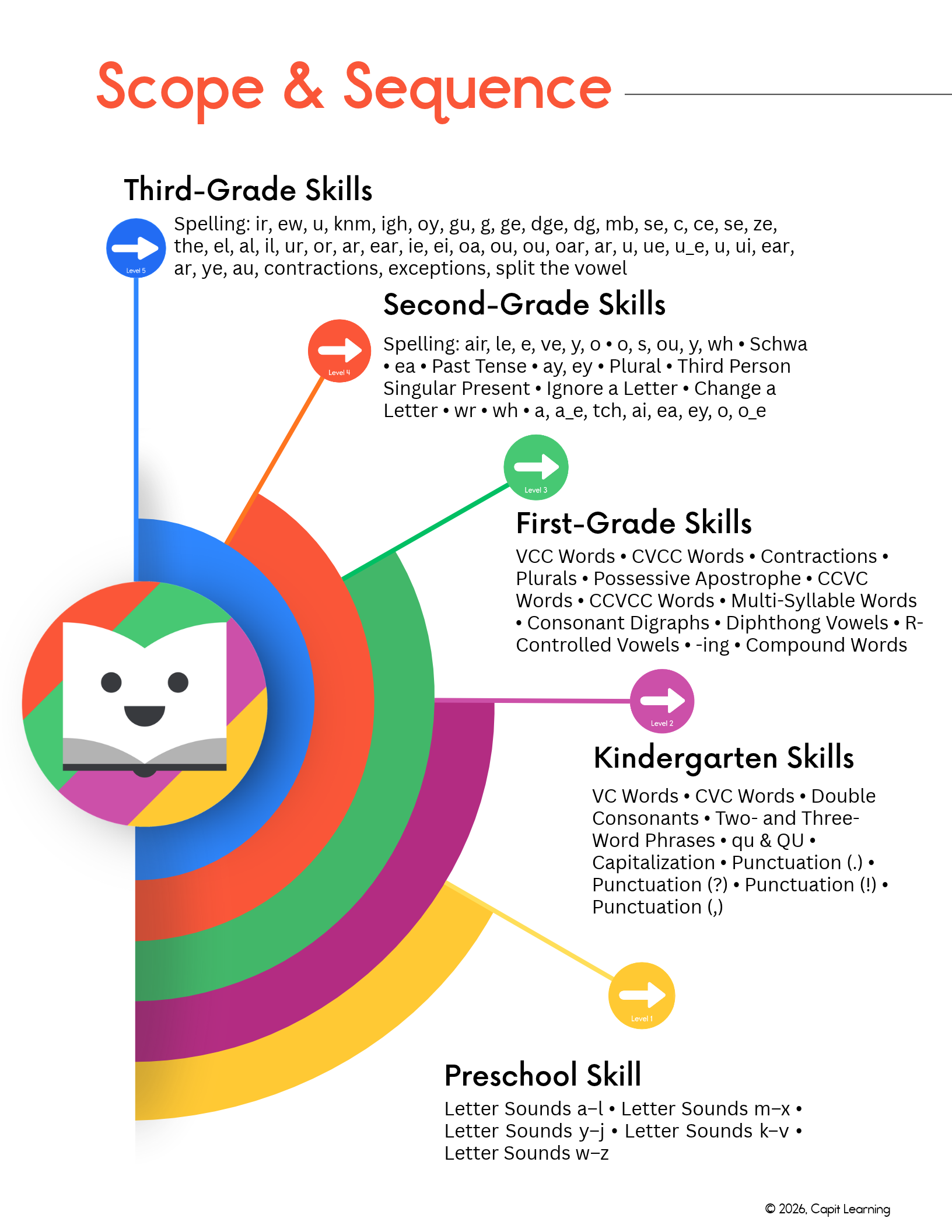
The big idea
Your child already speaks English, which means your child already says every sound in the language. Reading is the skill of matching those sounds to the letters that stand for them.
English makes this harder than it sounds, because it has more sounds than letters. One sound can be spelled several ways, as in rain, cake, and day. One spelling can stand for several sounds, as in bread and eat.
A thorough program does not leave these to chance. It teaches them one at a time, in an order where each lesson rests on the one before it. That order is called a scope and sequence.
Level 1 · Preschool skills
The sounds and the letters
Reading begins with sounds, and not with letter names. The name of the letter m is “em,” but the sound your child needs for reading is “mmm.” In Level 1 your child learns the sound of every letter, learns to recognize the letter, and learns to write it.
Each letter comes with a picture that looks like the letter and begins with its sound. The picture gives the sound and the shape a place to stick in your child’s memory.
By the end of Level 1, your child can see any letter and say its sound, and can hear a sound and find its letter.
What is taught
- Letter sounds a–l
- Letter sounds m–x
- Letter sounds y–j
- Letter sounds k–v
- Letter sounds w–z
- Letter sound
- The sound a letter stands for in a word, which is different from the letter’s name.
- Visual mnemonic
- A picture that helps the memory. Ours are shaped like the letters they teach.
Level 2 · Kindergarten skills
Blending sounds into short words
Knowing the sounds is not yet reading. Your child must learn to push sounds together to make a word, which is called blending, and to pull a spoken word apart into its sounds, which is called segmenting. Blending is how a child reads a new word. Segmenting is how a child spells one.
Level 2 starts with the shortest words in English and builds from there. Your child reads and spells two-sound words such as at, then three-sound words such as cat, and then reads short phrases. Capital letters and punctuation are taught here too, so your child is ready for real sentences.
By the end of Level 2, your child can read and spell short words without guessing, and can read short phrases.
What is taught
- VC words
- CVC words
- Double consonants
- Two- and three-word phrases
- qu and QU
- Capitalization
- Punctuation: period, question mark, exclamation mark, comma
- VC and CVC
- V stands for a vowel sound and C for a consonant sound. At is a VC word, and cat is a CVC word.
- Double consonants
- Two of the same letter that stand for one sound, as in bell and miss.
Level 3 · First-grade skills
Longer words and new kinds of sounds
Many children can read cat and then stall on stamp. The reason is that two consonant sounds in a row are hard to hear apart. Level 3 teaches these words step by step, adding one consonant at a time, until your child can read and spell words with five sounds.
Level 3 also introduces sounds that need two letters. Your child learns that sh is one sound written with two letters, meets vowel sounds such as the one in cow, and learns what the letter r does to a vowel in a word such as car. By the end, your child is reading words with more than one syllable.
By the end of Level 3, your child can read and spell longer words, including compound words and words that end in -ing.
What is taught
- VCC and CVCC words
- CCVC and CCVCC words
- Consonant digraphs
- Diphthong vowels
- R-controlled vowels
- Multi-syllable words
- Compound words
- The ending -ing
- Plurals
- Contractions
- The possessive apostrophe
- Consonant cluster
- Two or more consonant sounds side by side, as in the st and mp of stamp. Each sound is still heard.
- Consonant digraph
- Two letters that stand for one sound, as in ship, chin, and thin.
- Diphthong
- A vowel sound that glides from one mouth position to another, as in cow and coin.
- R-controlled vowel
- A vowel whose sound changes because an r follows it, as in car and fork.
Level 4 · Second-grade skills
One sound, several spellings
This is the part of English that most programs teach as a long list of rules and exceptions. We teach it as a filing system. Picture each sound as a folder, with its spellings filed inside. The vowel sound in cake can also be spelled as it is in rain, great, and they, and your child learns those spellings together because they belong to the same sound.
Level 4 also teaches the grammar that changes how words are spelled, such as the past tense and plurals, and it introduces the schwa, which is the most common vowel sound in English.
By the end of Level 4, your child can read and spell words that do not look the way they sound, because your child knows which spellings each sound can take.
What is taught
- Some of the spellings: a, a_e, ai, ea, ey, ay, o, o_e, ou, le, ve, air, tch, wr, wh
- The schwa
- Past tense
- Plurals
- Third person singular present
- Ignore a letter
- Change a letter
- Spelling alternatives
- The different ways one sound can be written. The sound stays the same and the letters change.
- Schwa
- The quick, relaxed vowel sound in an unstressed syllable, such as the a in about.
- Split vowel
- A vowel spelling whose two letters are separated by a consonant, as in the a_e of cake.
Level 5 · Third-grade skills
The rest of the code
Level 5 finishes the job. Your child learns the remaining spellings of English, including the less common ones that appear in the books children want to read on their own, such as the spellings in night, bridge, lamb, and new.
Contractions and true exceptions are taught here, after your child has the whole system to compare them with.
By the end of Level 5, your child has been taught the full spelling code of English and has the tools to read an unfamiliar word alone.
What is taught
- Some of the spellings: ir, ur, or, ar, ear, oar, ew, ue, u_e, ui, oy, au, igh, ie, ei, oa, ou, ge, dge, mb, gu, ce, se, ze, el, al, il
- Contractions
- Exceptions
- Split the vowel
- The code
- The full set of connections between the sounds of English and the letters that spell them.
- Exception
- A word with a spelling that appears in very few other words. There are far fewer of these than most people think.
What runs through every level
Reading and spelling together
Your child learns to spell the words that your child learns to read. Spelling is the proof that a sound and its letters are truly known. You can read more on our Sound-to-Print page.
Handwriting
Your child traces and writes the letters from the first level, because forming a letter by hand helps a child remember it.
Vocabulary, fluency, and comprehension
Decoding is the door to reading, and understanding is the room behind it. The levels build toward reading passages and understanding them.
Where does your child belong in this sequence?
The free Phonics Check takes a few minutes and shows you the level where your child would most likely begin.